
Picture a Saturday in May. The sun is barely up in Fort Kent. Two yellow buses idle in the school lot, one for the baseball team, one for the softball team. Both are pointed south. Both are going to the same place: Washington Academy, in East Machias. That's 220 miles away. One way. About four and a half hours of bus, assuming nobody stops, which of course they do. By the time these kids get off the bus, stretch, eat something, and play a game, they will have spent more of their Saturday on Route 1 than off it. Then they get back on. Then they drive home. Then it's dark again.
This is Maine high school spring sports. Welcome to the Road Trip corner of Analytics207.
Maine Is Bigger Than People Think
The state runs about 320 miles tip to tip. A school bus at 45 mph needs a little over seven hours to cover the whole thing. Aroostook County schools (Fort Kent, Caribou, Presque Isle, Houlton, Madawaska) routinely play Class B and C opponents on the coast, and the coastal schools occasionally have to make the return trip. Most of the 200-plus-mile trips this spring involved Aroostook teams going somewhere or somebody coming to get them.
So when we talk about "long bus rides" in Maine, we are not talking about an inconvenient hour through traffic. We are talking about an entire calendar day, two buses' worth of gas, and a coin flip on whether you have anything left in your legs at the other end. Let's look at five of those days.
Fort Kent's May 2: The Worst-Case Version
On May 2, Fort Kent baseball and Fort Kent softball both made the 220-mile trip to Washington Academy. Two separate teams. Same school. Same day. Two buses, two drivers, roughly 880 miles of total bus time charged to one school district.
Result: Fort Kent baseball lost 17-1. Fort Kent softball lost 13-0. Combined score of the day: 30-1.
That is the worst version of the long road trip. It is also a useful data point, because Washington Academy baseball ran 14-0 this spring. Sometimes the bus ride is not the thing that hurt you. Sometimes you just drove four and a half hours to play a team that was going to beat you in your own gym.
MDI's May 16: The Best-Case Version
Same setup, different result. On May 16, Mount Desert Island baseball and MDI softball both traveled 207 miles to Caribou. Doubleheader day, MDI buses going north instead of south.
MDI baseball won 10-0. MDI softball won 19-2. Combined: 29-2 the other direction.
If Fort Kent's May 2 was the cautionary tale, MDI's May 16 is the rebuttal. Drove all morning. Swept Caribou by 27 runs. Drove all evening home. Whatever the gas cost, the trip cleared it.
Morse Girls Lacrosse, April 24: 218 Miles For One Goal
On April 24, Morse girls lacrosse boarded a bus and drove 218 miles to play the Northern Maine Moose, the Houlton-area co-op. They won 12-11.
Four-plus hours each way. Fifty minutes of lacrosse. Won by one goal. That is a road win in the truest sense of the word. Nothing about that day was easy and nothing about that day was wasted.
The Orono / Fort Kent Shuffle, May 16
May 16 was a busy day on Maine's road network. While MDI was beating up Caribou, two other long trips were happening. Orono softball drove 196 miles north to Fort Kent and won 11-0. Earlier the same day, Fort Kent softball had played Orono and lost 5-1. And Fort Kent baseball that day also went to Orono and won 7-4.
So: Fort Kent softball went 0-2 on the day across two opponents and a lot of asphalt. Fort Kent baseball banked a long-trip road win. Orono softball banked a long-trip road win going the other direction. One Saturday, multiple buses, one giant Venn diagram of who beat whom.
The Northern Maine Moose: Travel As A Way Of Life
If you want to see what a real travel program looks like in Maine HS, the Northern Maine Moose lacrosse co-op out of the Houlton area played FIVE separate 100-plus-mile one-way road games this spring across the boys and girls programs. Trips to Cony/Hall-Dale, Leavitt, Maranacook/Winthrop, and Lincoln Academy. Plus the home dates where Morse and Erskine drove up to them.
The boys side has won some, lost more. The girls side took that one-goal game against Morse described above. The numbers say the bus rides are not hurting the Moose analytically. The schedule says it does not matter what the numbers say, because this is just what their season looks like.
The Counterintuitive Stat
Here is where it gets weird. Across all 2,265 played baseball, softball, and lacrosse games on the Maine HS Slate this spring, away teams went 1,109-1,156. That is a 49.0 percent away win rate. Reasonable. Slight home edge. Nothing unusual.
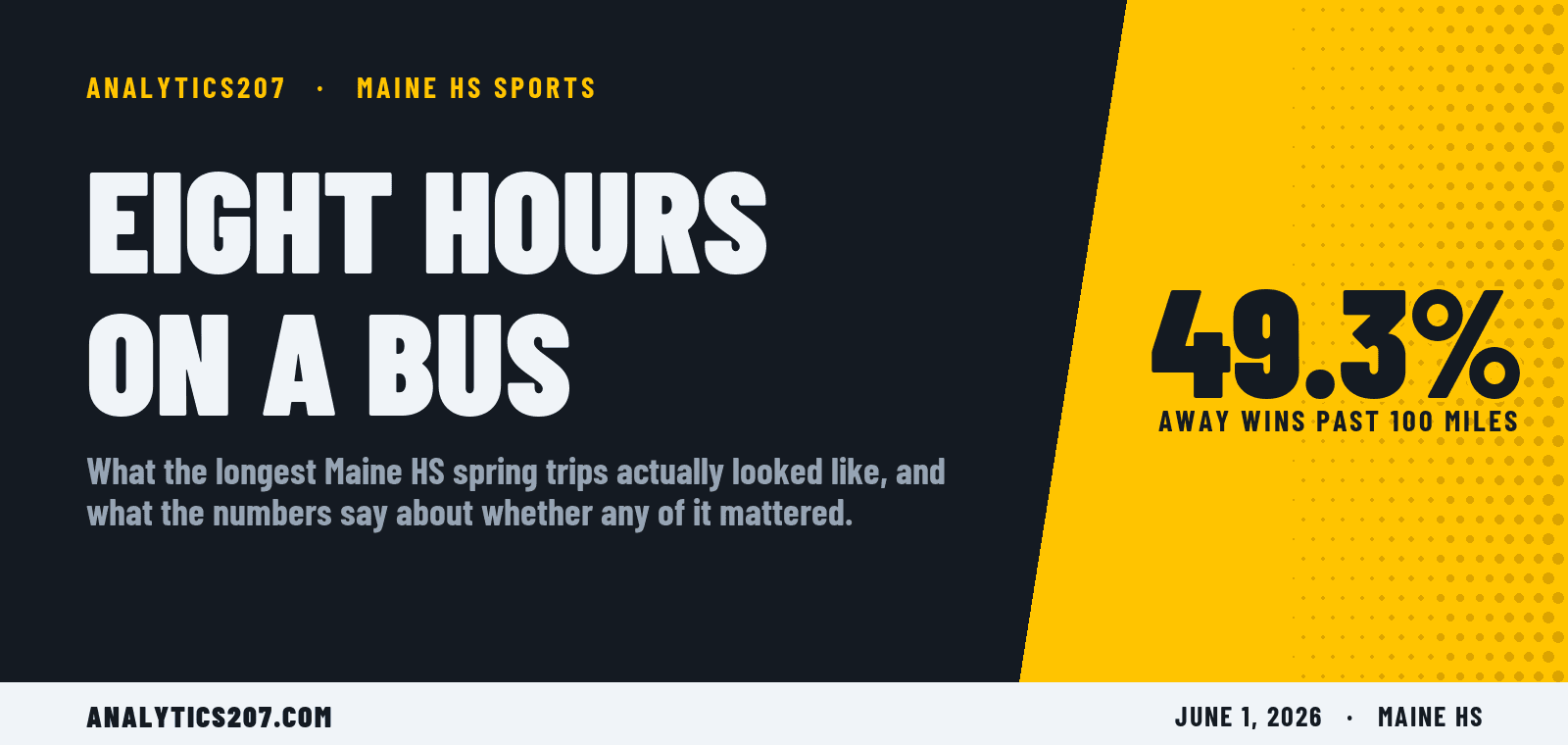
Now filter to trips of 100 miles or more one way. There were 201 such games. Away team record on those: 99-102. That is a 49.3 percent away win rate.
So the away win rate on a 100-plus-mile bus ride is 0.3 percentage points HIGHER than the overall away win rate. The bus, as far as the data can tell, does not move the needle. At all.
The kids who got on it absolutely do. But the bus itself? The bus is just a bus.
Why The Top 20 Still Looks Brutal
If you zoom in to just the 20 LONGEST road trips this spring, away teams went 6-14, a 30 percent win rate. That looks like proof that long trips are crushing visitors.
It is not. Two reasons. First, 20 games is a tiny sample, and tiny samples are noisy. Second, most of those 20 trips were Aroostook County teams traveling to play top-tier Class B and C coastal programs (Washington Academy baseball going 14-0 is a good example). Once you broaden out to the full 201-game sample at 100-plus miles, the win rate snaps right back to league average. The bus is not the problem. The opponent is the problem. Those are different things, even when they happen on the same day.
This is the same lesson Heal Points teaches every year: opponent quality is doing most of the work people credit to fatigue or travel or vibes.
What It Actually Costs
A 200-mile one-way trip at 8 mpg and $4 a gallon is about $200 in fuel alone before anyone gets paid. Double it for a doubleheader day with two teams from the same school. Now do that five times a season. Now do it for two sports. Aroostook athletic budgets are not theoretical.
The math says the bus does not matter. That is true. It is also the least interesting thing about any of this. Fort Kent kids spent nine hours on a bus on May 2 and got pasted twice. MDI kids spent eight hours on a bus on May 16 and walked away with two of the most lopsided wins of the spring. The Moose program treats a 200-mile road game as Tuesday. Morse girls lacrosse won by one goal after driving the equivalent of Portland to Boston and back.
The bus does not matter to the standings. The kids who got on it matter to everyone else.
Long way to go. Worth the ride.
More from Analytics207: Every call, graded · How we are doing