
We keep a scoreboard on ourselves
Every game GameIQ calls, it puts a number on: this team has a 71 percent chance to win, that one 44 percent. Those numbers are a promise. Over a long enough season, the teams we tag at 70 percent should win about seven times in ten. Not six. Not nine. Seven. This offseason the gremlins pulled every completed game off the shelf and graded that promise, sport by sport.
What came back was not a broken pick. It was a broken volume knob.
The finding: right more often than it let on
We sorted thousands of finished games by what GameIQ claimed beforehand, then checked how often those favorites actually won. Every tier told the same story, and it leaned the same way:
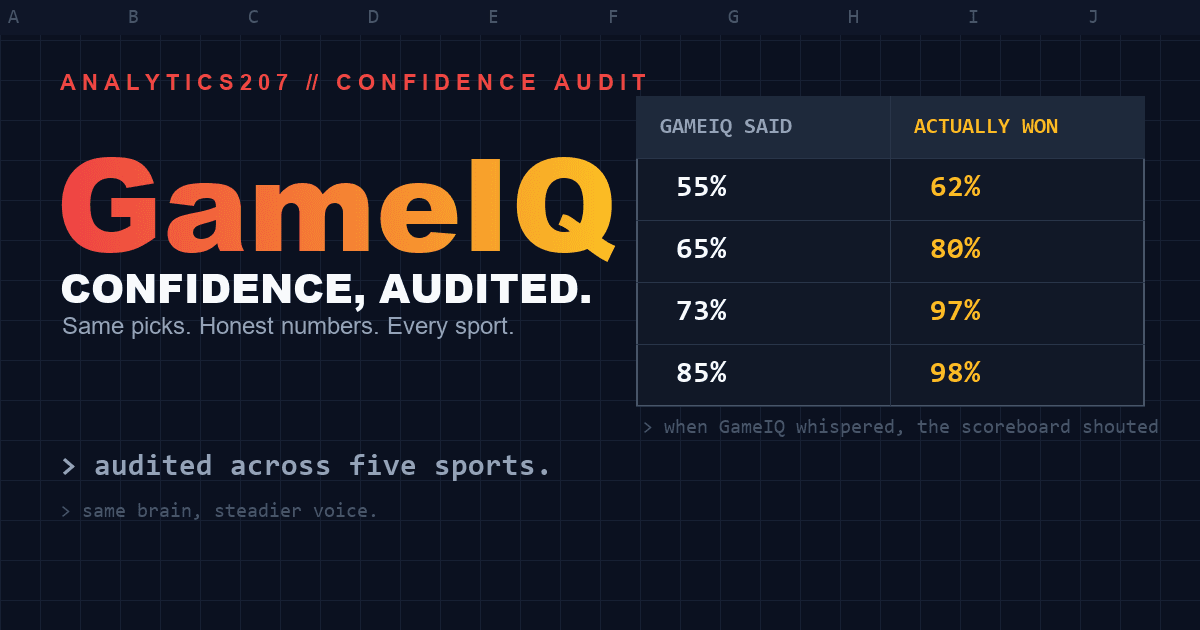
When GameIQ said 55%, the team actually won 62% of the time.
When GameIQ said 65%, the team won 80%.
When GameIQ said 73%, the team won 97%.
When GameIQ said 85%, the team won 98%.
Look at the second line. When GameIQ said a team had a two in three shot, that team was winning four out of five. The picks were sharp and the favorites were the right favorites, but the confidence pinned to them was consistently shy. GameIQ was underselling itself.
This was not one sport on a hot streak. The same gap showed up in basketball, soccer, hockey, field hockey and volleyball, across thousands of games combined, and it pointed the same direction every single time. When a pattern is that consistent and one sided, it is not luck. It is a setting.
Putting a number on how wrong
Calling the winner is only half the job. The other half is being right about how sure you are. To grade that half, we score every forecast by how far it lands from what actually happened, then average it across the whole season. Lower is better, and a perfectly honest forecaster pushes it toward zero.
Here is the satisfying part. Fixing the confidence cut that error by about ten percent, and the win or lose picks did not budge, still right roughly seven times in ten. We did not make GameIQ smarter about who wins. We made it honest about how much it actually knows.
Picture a 45 degree line: what we say on one axis, what happens on the other. An honest forecaster sits right on that line. GameIQ was living just underneath it, every sport, all season long. We nudged it back up onto the line.
Why a sharp system plays it safe
We are not going to pop the hood and show you the wiring. That part stays ours. The short, honest version: a careful system hedges. When something is built to avoid embarrassing itself, it drags its guesses toward the safe middle, and the safe middle is a coin flip. GameIQ was modest to a fault. The audit simply handed us the details to prove it and the map to correct it.
The one place we hold back on purpose
There is a stretch where a quiet, unsure GameIQ is exactly right: the opening games of a season. Rosters turn over, nobody has played a meaningful minute yet, and a coin flip is the honest answer. Crank the confidence there and you are just loud and wrong. So our correction stays switched off until each team has a couple of games on the board, then it kicks in. It covers the roughly ninety percent of the season where GameIQ has something real to stand on, and it steps aside for the part where it does not.
The bottom line
Nothing about who GameIQ picks has changed. The favorites are the same favorites. What changed is the honesty of the number sitting next to them. When you see a 78 percent on a game page now, it means a real 78 percent, weighed against thousands of games that already happened. Same brain, steadier voice.
The gremlins are already sharpening the next one.
More from Analytics207: This week's picks · Every call, graded · How we are doing